
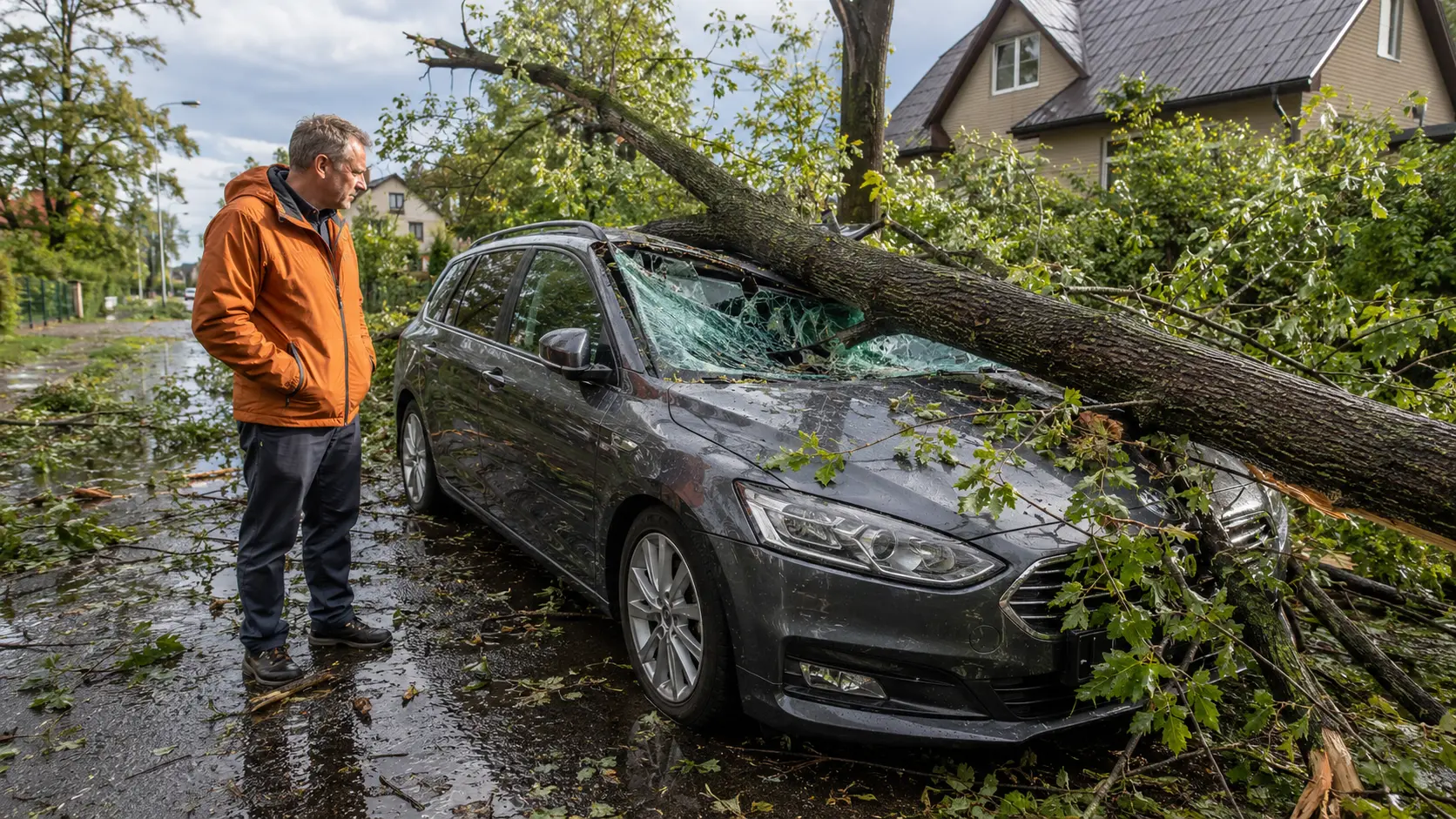
It is not just house roofs being torn off—storms in Lithuania are increasingly damaging cars as well.
Following severe storms, insurers are already tallying hundreds of damaged vehicles and losses running into the millions. Consequently, coverage against the forces of nature within comprehensive (KASKO) insurance is increasingly shifting from an optional add-on to one of the policy’s most critical components.
Over more than 30 years of working in the insurance market, I have witnessed changes in both the risks themselves and our perspective on them. In the past, from an insurance standpoint, storms in Lithuania were typically associated with residential property: a roof torn off, broken windows, a flooded basement, or a tree falling onto a building.
Storm-related damage to vehicles did not receive particular attention and was perceived as isolated or random.
Recent storms are changing this picture. Following severe weather events, insurers are increasingly reporting damage not just to isolated vehicles, but to hundreds at a time. Falling trees and branches, hail, wind-borne objects, and flash floods—the forces of nature are becoming a very real cause of vehicle damage.
Hundreds of cars damaged in a single storm
One of the most striking examples is 2023. August storms. BTA announced that it had received 235 reports of damaged vehicles, and the total damage to them amounted to approx 650,000 euros . Almost all of these incidents were related to hail: shattered windows and dented hoods and roofs. A significant number of trees and branches falling onto cars were also reported.
The storms of August 2023 were exceptional for the Lithuanian insurance market. “Lietuvos draudimas” announced that losses incurred by its clients—both private individuals and businesses—during two periods of storms in August approached €10 million, with the total loss later estimated at approximately €11 million. Trees fell onto both buildings and vehicles, while hail damaged roofs and facades as well as cars.
The severe weather that struck Lithuania on July 28–29, 2024, once again served as a reminder of just how extreme summer weather can be. At that time, the Lithuanian Hydrometeorological Service recorded catastrophic rainfall at five weather stations. In Telšiai, as much as 110.1 mm of precipitation fell in no more than 12 hours, while rainfall of such magnitude had never before been recorded in Šiauliai or Mažeikiai.
The storm of August 22, 2026, provided yet another very clear example. According to data from the Lithuanian Hydrometeorological Service, winds classified as dangerous or stronger were recorded that day at all Lithuanian meteorological stations that measure wind parameters, with gusts reaching 33.1 m/s in Ventė. Based on data available since 1970, this was the only summer storm during which such wind speeds were registered at all these stations.
In just a few days following this storm, “Lietuvos draudimas” received more than 4.6 thousand claims , the preliminary value of which reached €3.6 million. The company later announced that more than 200 inquiries specifically concerned damaged vehicles.
By the very first working day following that same storm, BTA had already registered around 100 Casco insurance claims. An interesting detail is that, although there were significantly fewer claims for vehicle damage than for residential property damage, the amounts reserved for both categories were similar at the time. This clearly demonstrates that the cost of repairing a single vehicle can be very high.
A storm doesn't choose its car.

The risk of traffic accidents is heavily influenced by the driver themselves—their experience, how the vehicle is used, the distance driven, and a multitude of other individual circumstances.
The risk posed by the forces of nature is different.
Hail doesn’t care whether a small city car or a powerful SUV is parked in the lot. A branch snapped by the wind doesn’t choose a car based on the driver’s experience. A suddenly flooded street inundates a car bought yesterday just as it does one purchased ten years ago.
Of course, the extent of potential damage varies. Repairing a modern car’s panoramic roof, LED headlights, cameras, radars, or other electronic systems can be very costly. Following the 2026 storm, *Lietuvos draudimas* also noted that vehicle damage caused by the forces of nature can, in some cases, amount to several thousand or even tens of thousands of euros.
However, the actual fact of whether a car ends up exposed to a hailstorm, a tree toppled by a storm, or rising floodwaters has far less to do with its make or the driver’s skills.
And that is precisely why the risk posed by forces of nature is becoming increasingly significant in comprehensive vehicle insurance (CASCO).
We’re preparing the house for the storm. But what about the car?
When we get a warning of an approaching storm, the common homeowner already knows what to do.
We close the windows and doors. We check whether there are no light objects left in the yard. We unfold umbrellas, fix or bring outdoor furniture, arrange a trampoline. We assess the condition of the roof, gutters and downspouts. If there are old trees around the house, we pay attention to dangerous branches.
This has become a fairly standard preventive measure. The exact same logic should be applied to the car as well.
If strong winds are forecast, you should not leave your car under large trees or near advertising structures, scaffolding, or other objects that the wind could knock over or lift.
If hail is forecast, the best protection is a roof – a garage, carport, multi-storey or underground car park.
If heavy downpours are expected, it is also worth considering the terrain. A car parked at the lowest point of a yard, street, or underground parking lot could end up submerged during a sudden rainstorm. Insurers recommend choosing a higher parking spot whenever possible.
The principle of prevention is the same in both cases: if we are aware of a danger in advance, we must take the opportunity to reduce the risk.
Flooded street – damage that can often be avoided.
One situation where a great deal depends on the driver themselves is attempting to drive through a flooded section of road.
It is often difficult to gauge the actual water depth from inside the car. Furthermore, we cannot see what lies beneath the water—the road surface may have been washed away, or there could be potholes or other obstacles.
Even more importantly, if water enters the engine or the car’s electrical systems, the damage can be severe. If the car stalls in the water, attempting to restart it could simply worsen the damage. Therefore, when approaching a flooded section of road without knowing its depth, the safest course of action is not to hope you can make it through, but to turn around.
This is very similar to home insurance: insurance does not absolve us of the obligation to act sensibly and, whenever possible, minimize potential damage.
However, we cannot protect the car from everything.
Prevention has its limits.
We may not leave the car under a tree, but we cannot predict exactly where the hail cloud will pass.
We might choose a higher parking spot, but an exceptionally heavy downpour can sometimes flood—within just ten to fifteen minutes—even those streets or lots that previously had no such issues.
We might keep the car in the home garage, but a storm could catch us at work, at a shopping mall, or while traveling.
Meanwhile, a container lifted by the wind, a part of a building structure, or a broken branch from a tree that appeared perfectly healthy represent risks that a car owner cannot objectively control.
Insurance is not a substitute for prevention. Its purpose is to assume the portion of risk that the individual can no longer control.
This is precisely where the significance and purpose of KASKO insurance lie.
Forces of nature in Casco insurance – no longer just a symbolic risk
Mandatory civil liability insurance for vehicle drivers is intended to compensate for damage caused by the driver to others. It is not intended to compensate for damage to the car itself caused by a storm, hail or fallen tree.
Such risks typically fall within the scope of comprehensive vehicle insurance (KASKO). However, as is always the case with insurance, it is important to evaluate the terms of the specific offer, the covered risks, the deductibles, and the exclusions.
Even just over a decade ago, coverage against the forces of nature within a comprehensive car insurance (KASKO) policy might have seemed like a rather theoretical component to a vehicle owner. Traffic accidents, theft, vandalism, or broken glass appeared far more significant.
Recent events are forcing a shift in this perspective. When, following a single storm, one insurer records over 200 damaged vehicles and another registers around 100 comprehensive insurance claims, we can no longer view the forces of nature as an exotic, unlikely scenario.
Is the increasing risk of storms already reflected in the price of comprehensive car insurance (KASKO)?
Insurance companies’ CASCO pricing models are not public, so it would be inaccurate to claim that Lithuanian insurers currently automatically add a specific “storm surcharge” to every CASCO policy.
However, the very logic of insurance pricing is clear: when the frequency of risk or the magnitude of potential losses changes, this must eventually be reflected in the insurance price.
The European Insurance and Occupational Pensions Authority (EIOPA) notes that, as physical climate risks increase, risk-based insurance premiums should rise over time. EIOPA also urges insurers to recalculate natural catastrophe risk parameters—including risks associated with floods, windstorms, and hail—based on more recent climate data and risk models.
This does not mean that storms will drive up comprehensive car insurance premiums equally for every vehicle. The potential cost of damage is heavily influenced by the car’s value, design, and repair costs, while the insurance price is also determined by many other risk factors. For instance, the Bank of Lithuania notes that property insurance payouts decreased in 2025 due to more favorable weather conditions. One year might be calm, whereas in another, a single storm could cause thousands of claims within just a few hours.
However, it can reasonably be argued that forces of nature are becoming an increasingly important component of overall Casco risk, which insurers must assess alongside other causes of loss.
Before a storm, it is worth thinking about more than just the roof of the house.
In Lithuania, we have already learned that upon receiving a warning about strong winds or heavy rain, we need to secure our homes. Now, we should take similar precautions with our cars.
Upon receiving a severe storm warning, it is advisable to:
- assess where the car is parked and pull it away from trees and unstable structures;
- if there is a risk of hail, look for a garage, carport, or covered parking area;
- if heavy rain is forecast, avoid the lowest parking spots and areas prone to flooding;
- refrain from making non-essential trips during a storm, and do not attempt to cross a flooded section of road;
- together to assess whether the car insurance coverage covers damage caused by natural forces.
We cannot avoid all the consequences of the storm. But we can reduce their probability and decide in advance what remaining financial risk we are ready to take on ourselves.
Before the storm, we make sure that the windows of the house are closed and the roof is safe. More and more often, it is worth looking out of that window at the same time – where our car is parked.

Marius Jundulas
- Also read

Even a dream vacation can be ruined by an unexpected event – illness, injury or lost luggage. Travel insurance is a real help that can

What is important when traveling on vacation to a warm sea?
One of the most important things is travel insurance. Not because something will definitely happen, but because if it does, you want to be prepared.

You encountered a bear – who will compensate for the losses?
Bears have returned to Lithuania. They seem to be interested not only in honey, but also in running around city streets and people’s yards.

Driving abroad: how to prepare for a car trip around Europe?
Learn how to prepare for a family road trip around Europe: what documents are needed, how to prepare the car, and why travel insurance is

Travel insurance – now on the “Man ramu” platform!
Whether you are going on vacation to warm countries or going on active vacations in the mountains, with the right insurance, your trip will be

Don’t drive with a “snow cap”: why 5 minutes in the yard is more important than rushing
“Man ramu” shares key insights on why your car’s roof, lights, and windows must be clean before you leave your place.