All-inclusive in Turkey: a false illusion of security and the necessity of travel insurance

The illusion of an all-inclusive package and the psychological security barrier

Turkey remains one of the most popular holiday destinations among Lithuanian travellers, and its resorts, such as Antalya, Kemer and Bodrum, are famous for their highly developed all-inclusive concept. This model is associated with consumers as a guarantee that everything is financially covered, as transport, accommodation, meals and entertainment are paid for before leaving the country. However, this pre-payment creates a dangerous psychological sense of security, when travellers mistakenly equate the service package with comprehensive personal and medical security.

In reality, the protection provided by hotel management is strictly limited in terms of territory and law. The liability insurance held by a hotel usually covers only those accidents that occur directly due to the fault of the establishment itself or defects in the infrastructure, for example, slipping on a poorly maintained wet surface near the pool, and its payments are more symbolic. This hotel liability does not cover any common health problems, acute infections, injuries outside the hotel, emergency medical evacuation or lost personal property.

Lithuanian PSD and ESDC are not valid in Turkey

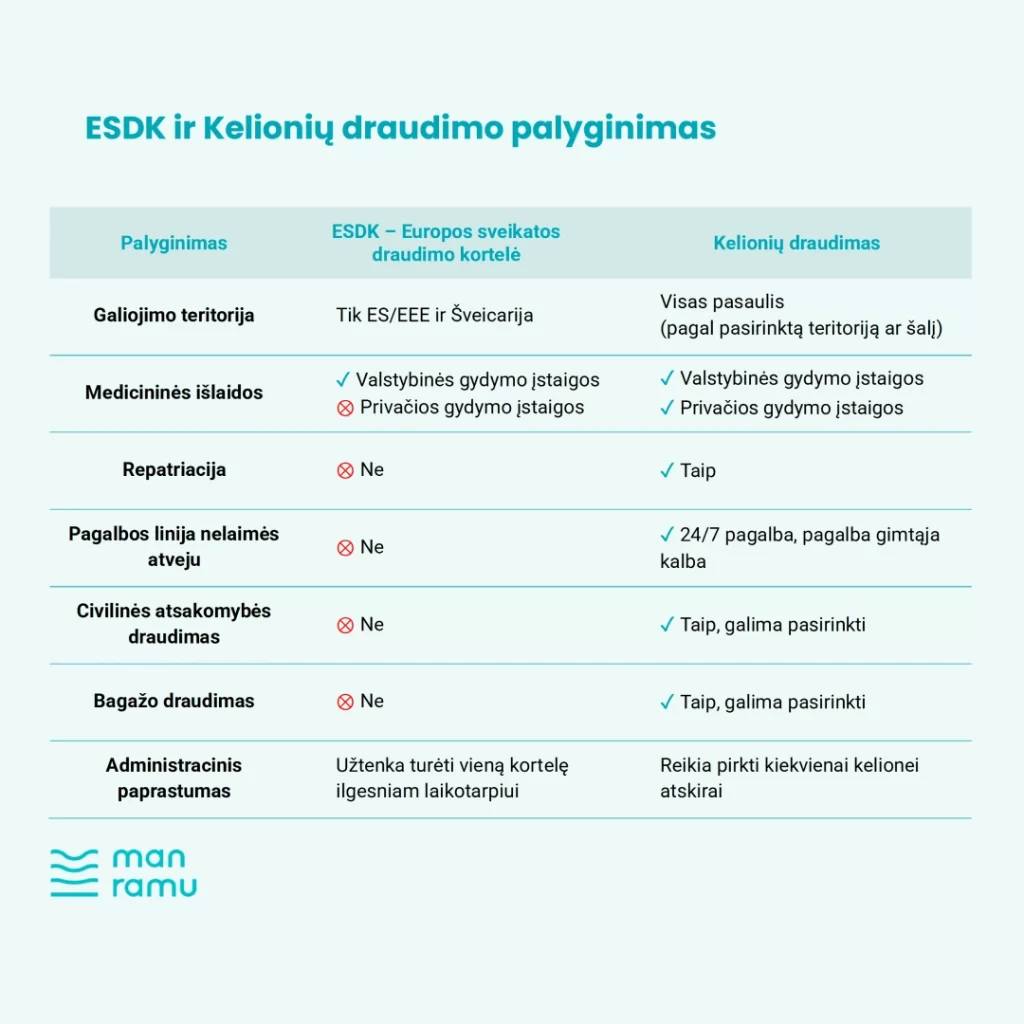
Another common mistake made by Lithuanian travelers is relying on the European Health Insurance Card (EHIC) or assuming that the compulsory health insurance (CHI) paid in their homeland is valid worldwide.

Since Turkey is not a member of the EU or the European Economic Area (EEA), the EHIC has no legal force there. This document is not accepted in Turkish medical institutions, and Lithuanian state health insurance does not cover any treatment or hospitalization costs incurred in Turkey.

Turkey's private medical infrastructure and real financial costs

The Turkish medical market is characterized by a particularly high level of privatization and commercialization. The country has advanced private clinics, and the country itself is one of the world leaders in medical tourism, attracting thousands of patients for elective aesthetic, dental and surgical procedures. Although the prices of elective surgeries for foreigners are competitive here, the pricing of emergency care in resort areas for uninsured persons is very high and not controlled by the state. In the event of any health problem, the hotel administration or local ambulance almost always directs the tourist to private medical centers, such as the International Hospital or Acıbadem network, where service prices are adjusted to the commercial sector.

Comparison of prices of medical services and procedures in Turkey (2026 data)

Medical service

Price in Turkey

Additional context

Doctor’s consultation at a private resort clinic

€80 – €150

Applicable in resort areas for the initial visit and examination.

Hospitalization day in a private hospital

€500 – €1,200

Includes only ward, basic observation and nursing.

Poisoning treatment (hotel doctor)

€60 – €150

Emergency care, drip rehydration, antibacterial drugs.

Emergency dental care

40 € – 100 €

Anesthesia, emergency pain relief, temporary filling.

The most common reason for hospitalization of Lithuanian tourists in the coastal regions of Turkey is acute food poisoning. Even a minor medical intervention, such as a drip to stop dehydration, quickly reaches hundreds of euros in private medical facilities.

If the whole family gets food poisoning, the costs multiply proportionally to the number of people, as medical institutions bill each patient separately. A family travel insurance policy allows you to avoid these costs by covering the costs of treatment (from 60 to 200 euros per person).

Active leisure, natural hazards, altitude and alcohol limits

Turkish resorts offer a wide range of active leisure activities, but travelers often forget to check the terms and conditions of their insurance policies:

  • Extreme sports add-ons: If you are going to be doing extreme activities such as hot air ballooning in Cappadocia, scooter riding, jet skiing, surfing or mountain hiking, then you should make sure that your insurance policy includes an “active activities” or “extreme sports” add-on. Without this add-on, injuries sustained during the flight or other active activity will not be covered.
  • Altitude restrictions in the mountains: It is important for travelers planning mountain hikes to know that standard insurance coverage is often completely invalid in the mountains above 3,000 meters above sea level.
  • Natural and climatic risk factors: From April to October, there is a real risk of contracting tick-borne Crimean-Congo hemorrhagic fever (CCHF) on the Turkish coast and hiking trails, for which there is no vaccine, so prevention (repellents, body check-ups) is essential. In addition, in August, temperatures on the coast often reach 40°C, so sunstroke and dehydration become a real health threat – urgent hospitalization may be required.
  • Alcohol consumption exclusions: Although alcohol is legal and freely sold in Turkey, imported drinks are more expensive than in Lithuania due to high excise taxes. Therefore, the free local alcohol provided in all-inclusive hotels usually encourages its greater consumption. Travelers must understand that any accident that occurs while intoxicated is a standard insurance exclusion. If drunkenness is determined in a medical facility, the insurer has a legal basis to not pay compensation at all.

"All inclusive" does not relieve the traveler of responsibility for their own health

A thorough analysis of the Turkish tourism and medical market confirms that choosing an “all-inclusive” package does not relieve the traveler of personal responsibility for their health and financial security. Lithuanian travelers traveling to this region are recommended to follow these safety rules:

  1. Passport validity control: Lithuanian citizens traveling to Turkey for up to 90 days (within a 180-day period) do not require a visa, but they must have a passport valid for at least 6 months from the date of entry into the country. An identity card (IDC) is not suitable for entry into this country.
  2. Dietary hygiene in the first days: In the Antalya and Kemer regions, it is strongly recommended to avoid ice cubes in unpackaged water, unwashed green salads, and local ice cream for the first two days of travel, in order to allow the stomach to adapt to the different composition of the water.
  3. Matching active activities with the policy: Before concluding an insurance contract, it is necessary to accurately specify the planned entertainment (hot air ballooning, diving, quad biking) so that they are included in the list of risks. It is also necessary to check the altitude limits of the mountains if an active hike is planned.
  4. Helpline Coordination: In the event of any medical condition, it is recommended that you immediately contact your insurance company’s overseas helpline before accepting the paid services offered by the hotel doctor. This will allow the insurer to directly take over the financial settlement with the clinic, without the traveler having to pay out of personal pocket.

Travel insurance in Turkey is not a luxury, but an essential necessity. It acts as an invisible shield that allows you to enjoy your vacation without fear of potential financial losses in the thousands that are not covered by any hotel packages or government guarantees.

 „Man ramu“ draudimo platformoje galite įsigyti kelionių draudimą, apimantį medicinines išlaidas, nelaimingus atsitikimus, asmens civilinę atsakomybę ir bagažo draudimą.