It's time to change your window fluid to winter: don't wait for the cold
When the weather gets cold, it’s worth not only changing your tires, but also taking care of your car’s windshield washer fluid. The fluid used in summer can freeze at sub-zero temperatures as low as -1 °C, which means that the first frosts can paralyze the entire windshield washer system. To avoid inconvenience or even repair costs, it’s best to add winter windshield washer fluid in advance – before the frost.

Why you can't wait until it "freezes"

Summer window fluid is water-based, so it crystallizes when it freezes and can damage the nozzles or plastic tank. If the fluid has already frozen, it is impossible to “melt” it by adding winter fluid – winter fluid simply does not mix with ice.
If the window fluid has already frozen, it is best to leave the car in a warmer place for a few hours – for example, in an underground garage or a heated parking lot near a shopping center. Once the fluid has thawed, it should be completely drained and filled with new, winter fluid.
In addition, driving with frozen windshield fluid is very dangerous. Even in mild temperatures, roads in Lithuania are often sprinkled with salt solution, which forms an opaque, oily layer on the glass. Wipers without fluid cannot overcome it, so the field of vision decreases in just a few seconds – which is a direct threat to road safety.
Dangerous myths and errors
Boiling water – absolutely not. Pouring hot water into a tank or onto glass is very dangerous. The sudden temperature difference can cause glass to break and plastic pipes to deform.
Dilution – not as simple as it seems
It is often believed that by mixing two liters of winter fluid designed for -20 °C with two liters of summer fluid, we will get a mixture resistant to -10 °C. Unfortunately, this is not the case. Mixtures of this type have a nonlinear reaction to temperature – when diluted in half, frost resistance can decrease by more than half. It is possible that such a fluid will freeze already at -5 °C. Therefore, it is better not to mix different types – pour one type, having previously used up or drained the old one.
What winter fluid is best?
It is often believed that it is best to choose the strongest one – for example, marked “–25 °C” or even “–30 °C”. However, this is not necessary. In the Lithuanian climate, a liquid with a temperature of -20 °C is usually sufficient. A stronger one is only useful for those who often travel to the mountains or regions where the temperature drops below -25 °C.
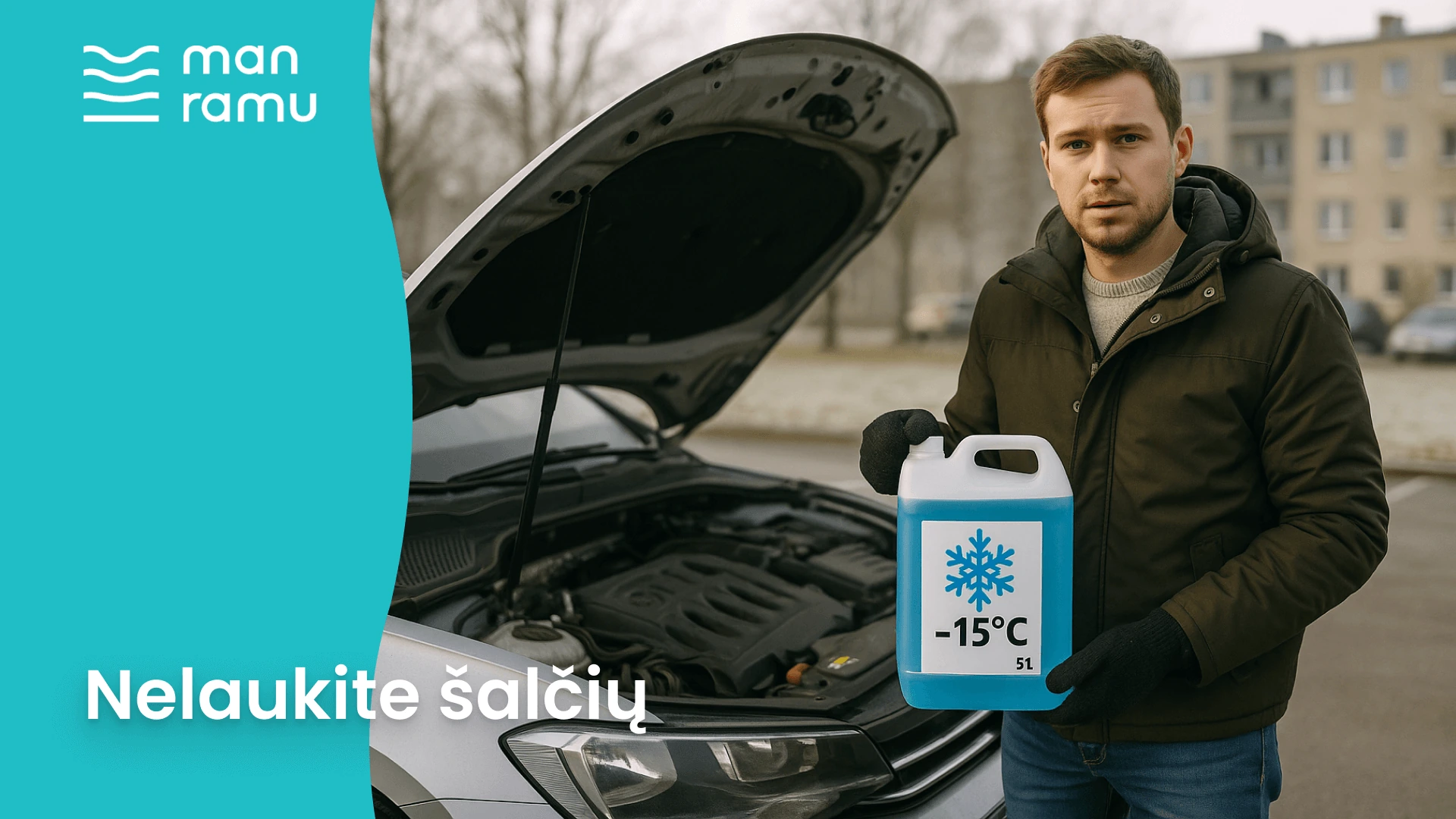
It is worth knowing that a stronger liquid is usually thicker, so it evaporates less easily in temperatures above zero or slightly below zero and can leave streaks on the glass. Therefore, if you drive in the city most of the winter, a medium-strength option (-15 °C or -20 °C) is sufficient.
It is more important to pay attention to the smell – excessively pungent or “technical” smells may indicate a lower quality product, the vapors of which are unpleasant to breathe in the cabin. The color also has no effect on freezing – it is just a pigment chosen by the manufacturer.
Is it worth having a spare fluid?
Yes, it’s worth it. A small 3-5 liter canister in the trunk is an easy way to avoid winter troubles. In some cars, the window washer system uses up fluid faster than expected, especially when driving on highways or after road salting. Having a spare canister can prevent a situation where the nozzles stop working during a trip and visibility drops to a minimum. Choose a tightly sealed canister and do not store it in the cabin – the fumes can be unpleasant.
When to change and how to do it?
It is best to do this in late October or early November, when the days are not yet cold.
To switch from summer to winter, you just need to:
- Use up or spray away any remaining summer liquid.
- Add winter fluid until the tank is full.
- Turn on the window washers a few times to flush out any summer residue from the systems. Don’t forget to wash the rear window.
This way, the system will be protected and the car will be ready for the first frosts.
In summary
Windshield fluid is a small thing, but its freezing can mean not only inconvenience, but also a technical failure or danger on the road. So don’t wait until the thermometer drops below zero – change your windshield fluid now and drive with peace of mind.
✅ We remind you:
You can quickly compare and purchase mandatory third party liability and CASCO insurance on the Man ramu insurance platform.
Palygink draudimo kainas per kelias minutes!
- Also read

Which is better – to arrive 5 minutes early or to be 5 minutes late?
A five-minute margin reduces stress and the risk of errors. How to plan your morning, your route, and arrive on time without rushing.

When do you renew your compulsory car insurance?
40% of drivers hesitate about when to renew their insurance. Find out why it’s not worth delaying and how to avoid risk and financial losses.

When Animals Speak: A Magical Legend of Christmas Eve
Did you know that according to Lithuanian folklore, animals speak in human voices on Christmas Eve? Find out the meaning of this legend and why

Battery check before winter: how to avoid unpleasant surprises on a cold morning
When the cold weather arrives, the car battery becomes the weakest link. Find out how to check its condition, when it is enough to charge

“Golden hour” for photographers can be “black” for drivers
In autumn and spring, the low sun in the morning and evening becomes a real test for drivers. Find out what insurer statistics show and

Lithuanian New Year’s trips to exotic countries – let’s not forget insurance
Lithuanian winter holiday trips to Egypt, Thailand, Indonesia, Maldives and other exotic countries: the most popular destinations, price trends, common health problems and why it