
Children to school - drivers to traffic jams. How to stay calm?
At the beginning of September, Lithuanian cities shift to a completely different rhythm of life. Up to 350,000 children are returning to school this year, the holiday season is ending, students are coming back to the major cities, and parents are once again making stops at schools and kindergartens during their daily commutes. All this means more cars on the road at the same time, heavier morning and evening rush-hour traffic, and significantly less tolerance for driver errors.

In Vilnius, it is estimated that the traffic intensity increases by approximately 9-20 percent every year at the beginning of autumn. But the increased number of cars is not the only reason for September’s congestion. This year, street repairs, route changes, poorer weather and, perhaps most importantly, our own haste contribute to them.
This shift is clearly evident in insurers’ statistics. According to BTA data, 4,600 vehicle-related claims were registered across Lithuania in August 2025, whereas the figure exceeded 5,000 in September. During the morning rush hour alone—between 7:00 and 10:00 a.m.—669 insurable traffic accidents were recorded in September 2025.
Traffic jams seem unavoidable. However, that doesn’t mean we have to get stressed out in them.

The whole city returns to the streets in September.
It is traditional to blame students for the traffic congestion in September. At first glance, the explanation seems logical: thousands of young people arrive in Vilnius, Kaunas, and Klaipėda—some with their own cars—unfamiliar with the city streets and with less driving experience.
However, such an explanation is overly simple.
This year, BTA noted that heavier traffic in major cities began as early as the last few weeks of August, even before students had started their studies. According to the insurers, September sees the entire city returning to its usual rhythm almost simultaneously: employees commute to work after their holidays, parents begin driving children to schools and kindergartens, and the number of pedestrians, cyclists, and scooter riders increases.
In an earlier traffic analysis by BTA, students were identified as only the third most significant cause of traffic congestion in September. Primary factors cited included changing family travel needs and drivers’ own lack of preparedness for heavier traffic—such as poor planning regarding departure times and routes, as well as phone usage. Insurers’ studies also indicated that a portion of students do not begin driving actively in major cities until October, rather than September.
Thus, students contribute to traffic volume, but it would be inaccurate to say that they are the ones “causing September traffic jams”. In September, the whole daily routine of the city changes.
Not all summer renovations end with the summer.
Another factor this year is road and street repairs.
Summer is a convenient time for road repairs because city traffic is lighter. However, September 1st does not necessarily coincide with the completion of construction work.
According to Vilnius Municipality data, work was still underway on street sections totaling approximately 14 kilometers at the end of August. While some roadway work was completed by September, major projects on Trakų, J. Basanavičiaus, B. Radvilaitės, Maironio, V. Kudirkos, Jogailos, Vilniaus, Džiaugsmo, and other streets are continuing into the autumn. Drivers are advised to assess the situation in advance during rush hours and, if possible, choose alternative routes.
A similar situation prevails in Kaunas. Although the Southeastern Bypass, the Kaunas Hydroelectric Power Plant bridge, and several other key arteries were successfully opened before September, work is still underway on Užnemunės, Julijanavos, H. and O. Minkovskių, and Baltijos streets, as well as on Baltų Avenue, Šilainiai Highway, and other locations. Specialists from the Kaunas Municipality also predict that traffic conditions do not typically return to normal overnight; drivers need time to adjust to new routes and the city’s altered rhythm.
That is why, at the beginning of September, it is worth re-checking even the route you have been taking to work for years. A commute that took twenty minutes in August could take significantly longer in September.
Heavier traffic leaves less room for error.
It is usually not major accidents that occur in traffic jams, but rather run-of-the-mill ones: one driver brakes too late, another misjudges the distance, and a third changes lanes at the last moment.
In its 2026 communications, BTA highlights safe following distance, speed, proper use of signals, and attentiveness as the most critical factors amidst increasing traffic. Insurers also remind drivers of the simple “zipper” principle: traffic flows more smoothly when drivers cooperate—rather than trying to overtake or block one another—as the road narrows.
This is where a traffic paradox lies. When it feels like we are moving too slowly, a natural urge arises to take action—to switch lanes, look for a faster lane, or overtake a car or two. However, constantly darting between lanes rarely yields any real benefit. A few hundred meters later, the same cars end up meeting again at the traffic light, while the extra maneuvering only increases the risk of a collision.
Sometimes the best way to get through a traffic jam faster is simply to drive through it calmly.
Children are returning to the streets – drivers need to be more attentive.
It is not just traffic patterns that change in September; hundreds of thousands of students also return to the streets.
According to data from the Transport Competence Agency published by Lietuvos draudimas, 241 children under the age of 11 and 451 children aged 12 to 17 were injured in traffic incidents in 2025. Compared to the same period in the previous year, the number of casualties increased in both age groups.
Particular caution should be exercised near schools, kindergartens, pedestrian crossings, and public transport stops. Primary school children are still learning to assess traffic situations independently. Between 2022 and 2025, 201 traffic accidents occurred within a 100-meter radius of general education schools and preschool institutions, resulting in injuries to 182 children.
Parents driving their children to school should decide in advance where to stop safely. It is best to let the child out on the sidewalk side and, before opening the door, ensure there are no cyclists, scooter riders, or other cars nearby. If a line of cars forms at the school gate, it is sometimes faster and safer to stop a hundred or a few hundred meters away and walk the final stretch.
A few saved minutes certainly do not justify leaving a car on a pedestrian crossing, at an intersection, or in a spot where it blocks other drivers’ view of children.
The biggest problem might not be the traffic jam, but our reaction to it.
When caught in a traffic jam, we often experience a very specific kind of stress: we feel we need to be somewhere, yet there is nothing we can do to get there faster.
Psychologist Inga Būdvytytė links this feeling to a sense of lost control. A person’s plans fall apart and they feel trapped, while the inability to change the situation gives rise to anxiety and irritability.
This is perhaps the most important lesson about traffic jams: once we are stuck in one, a large part of the situation is beyond our control. We might get angry at a slow-moving car, a novice driver, a senior citizen, road workers, or a driver who cuts in front of us, but none of that will make the line ahead move any faster.
On the contrary, emotional driving can only make the situation worse. Sudden lane changes, attempts to “teach another driver a lesson,” or aggressive driving increase the likelihood of an accident. And a single minor crash on a busy street can create an even greater traffic jam for hundreds of other drivers.
Using a phone while stuck in traffic is not an innocent way to pass the time.
When cars move just a few meters at a time, there is a temptation to use one’s phone. Yet, in precisely this kind of traffic, the situation is constantly changing: one moment we are at a standstill, and the next we need to move forward or brake.
Dr. Laura Šeibokaitė, an associate professor at the VMU Department of Psychology, once again highlighted the impact of mobile phone use on driving at this year’s “Regitra” conference. Using a phone impairs concentration, increases reaction time, and makes it more difficult to keep the vehicle within its lane. Each year, the police record approximately 43,000 instances of mobile phone use while driving, and around 600 people lose their driving privileges due to such violations.
Therefore, it is best to select your navigation route before setting off. If you need to change it while driving, it is safer to do so after stopping in a suitable location, rather than trying to watch both the screen and the line of traffic ahead at the same time.
You can start driving more calmly before you even leave home.
One of the simplest ways to reduce September stress is to allow a little more time for your journey.
BTA claims experts point out that a person running late is more likely to try to overtake slower-moving vehicles, make abrupt lane changes, and react more intensely to traffic congestion. When one has time to spare, the same situation is perceived quite differently: a missed traffic light or a slower car becomes not a problem, but simply part of the journey.
That is why, in September, it is worth breaking the habit of calculating your commute down to the minute. If your navigation app shows a 25-minute drive to work, that doesn’t mean you should leave home exactly 25 minutes before your meeting. You need time to walk to your car, pull out of your driveway, and find a parking spot—and, most importantly, you need a buffer of a few minutes to handle the unexpected.
Sometimes the difference between being five minutes early and being five minutes late is just ten minutes on the clock, but the driver’s feeling can be completely different.
It is worth checking the actual traffic situation before your trip, and—if possible—setting off a bit earlier or scheduling your journey outside peak traffic hours, at least during the first few weeks of September.
And what should you do once you are already caught in a traffic jam?
First, accept the fact that you are already stuck in traffic. Constantly calculating in your head how many minutes late you will be does not speed up the traffic.
If you realize you won’t arrive on time, it is best to let the person waiting for you know—either before setting off or after stopping at a suitable location. From that moment on, there is no longer any need to try to make up for lost time.
Then there are the simple things: maintaining a safe distance, staying in your lane, signaling turns in advance, and letting others in when necessary for smooth traffic flow. If you feel yourself getting very frustrated, it is worth making a conscious effort to lower the tension—breathe calmly, listen to music, or simply remind yourself that the traffic jam is temporary and you have no control over how fast it moves.
If your anger is so intense that you feel an urge to “teach another driver a lesson,” that is a signal not to try to discipline the other person, but rather to pull over in a safe spot and take a few minutes to calm down.
September traffic is also a good lesson in traffic culture for children.
Children in the car observe how their parents behave towards other road users.
You can explain ten times to a child that you need to be careful when crossing the street, but if on the way to school dad or mom curses a slow driver, misses a changing car and tries to pass when the red light is on, the child will remember exactly this pattern of behavior.
Therefore, the trip to school can also serve as a brief road safety lesson: explaining why we yield to a pedestrian, why one shouldn’t stand on a crosswalk, why we let another car change lanes, and why sometimes it is simply necessary to wait patiently.
Traffic culture begins not with a rulebook, but with what we see on the street every day.
If, despite everything, a traffic accident could not be avoided
Even the most cautious drivers can be involved in a traffic accident. If this happens, first ensure the safety of those involved and assess whether anyone requires urgent assistance. Safely document the circumstances of the incident, take photos of the vehicles’ positions and the damage, and—when conditions allow—fill out an accident report.
The most important thing in such a situation is not to rush or get drawn into a conflict. Spending a few extra minutes properly documenting the incident can save a lot of time later when clarifying the circumstances with the insurer.
On the “Man ramu” insurance platform, you can find information on what to do in the event of a traffic accident; if your car insurance is about to expire, you can compare compulsory motor third-party liability insurance (MTPL) and Casco insurance offers from several insurers and choose the most suitable one.
In conclusion: we cannot change the traffic jam, but we can change our behavior.
September traffic congestion is not a problem caused by students, parents, or road crews. It arises because the rhythm of life across the entire city shifts simultaneously after the summer. This year, the increased traffic volume is further compounded by ongoing infrastructure projects and the first weather surprises of autumn.
However, we can manage a significant portion of the risk ourselves.
Allowing a few extra minutes for the journey, checking the route before setting off, putting the phone aside, maintaining a safe distance, and not trying to “beat” other drivers on the road—these are very simple solutions.
The traffic jam might not get any shorter because of them.
But the journey will almost certainly become calmer.
Palygink draudimo kainas per kelias minutes!

- Also read

The price of insurance can vary by two! Find out what determines the price of compulsory insurance and why it is worth checking offers from
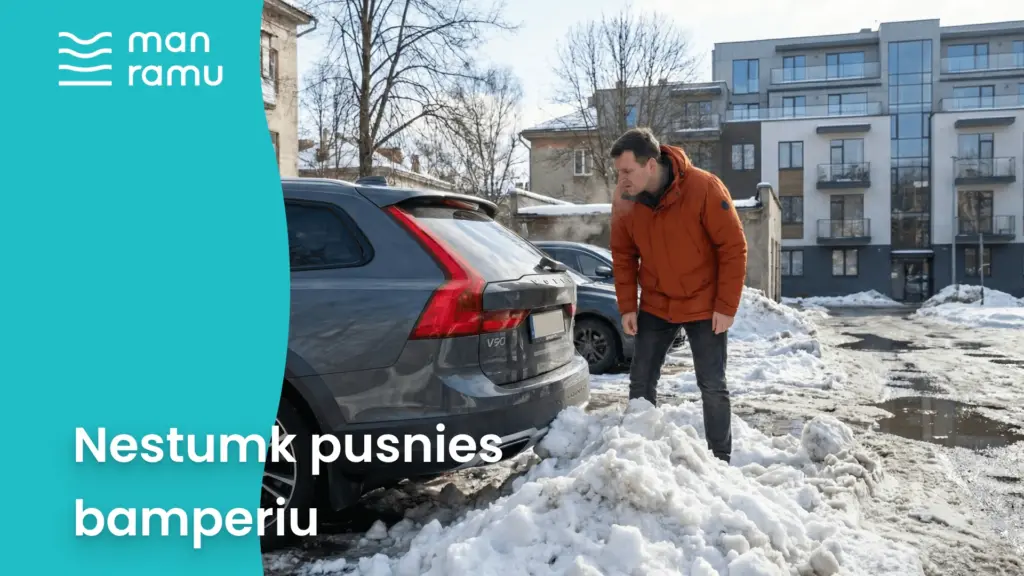
Don’t push a snowdrift with your car – you could lose more than just your bumper
During the winter, minor body damage increases, especially damage to front and rear bumpers, protective plastic parts, underbody protection, and parking sensors.

New tax – will insurance become more expensive from 2026? What is important for residents to know?
From January 1, 2026, all non-life insurance companies operating in Lithuania will have to pay a 10% security contribution tax on the amount of insurance

When do you renew your compulsory car insurance?
40% of drivers hesitate about when to renew their insurance. Find out why it’s not worth delaying and how to avoid risk and financial losses.

Rubber or textile car mats in winter?
We compare rubber and textile mats for winter: protection from salts, drying, footwear, aesthetics, care and recommendations.

Phones at the wheel: browsing is more dangerous than talking
Are you standing in a traffic jam or at a traffic light? Then you are participating in traffic – the Road Traffic Act prohibits taking